Espresso Accessory Compatibility: Get the Fit Right
A beautiful walnut portafilter handle or a precision dosing funnel should feel like it belongs on your bar, not like a near-miss you have to force into place. Espresso accessory compatibility is what separates a satisfying upgrade from an expensive return. Brand names help narrow the field, but the real answer usually lives in the measurements, connection style, and exact machine or grinder model.
For enthusiasts who care about both workflow and presentation, compatibility deserves the same attention as basket size, grinder alignment, or water recipe. A replacement part must physically fit, operate safely, and look proportional to the equipment around it. That is especially true with handcrafted wood components, where the final piece is made to complement a specific machine rather than imitate a generic plastic original.
Why Espresso Accessory Compatibility Is More Than Brand Matching
It is tempting to search for an accessory by brand alone: Breville, Lelit, ECM, Rocket, Gaggia, La Marzocco, Profitec, Bezzera, or another familiar name. That is a useful starting point, but it is not a fitment guarantee. Manufacturers often use different parts across product lines, revise components over time, or share a platform with a different model under the same brand.
A portafilter handle is a good example. Two machines may both use 58 mm baskets, yet their portafilter handles can have different thread sizes, thread depths, or attachment methods. A steam knob can appear nearly identical to another knob but use a different shaft shape, set-screw position, spline count, or valve interface. The part may look correct in a product photo and still be wrong for the machine.
Compatibility also has a functional side. A dosing funnel that sits loosely on a basket can shift during WDT and scatter grounds. A tamper that is technically 58 mm but undersized for a precision basket can leave an uneven ring of coffee at the edge. A flow control knob that does not align correctly with the valve can compromise both usability and the finished look of the upgrade.
Start With the Exact Model, Not the Product Family
Before ordering, identify the full model name and, when possible, its production generation or year. “Breville Barista” or “Lelit Mara” may be too broad. Model variations can change portafilter dimensions, hopper lids, steam knob hardware, and other details that matter.
Check the machine badge, original manual, purchase record, or manufacturer label. For grinders, look at the model number on the base or rear panel. If a machine has been repaired or modified, do not assume every visible component remains stock. A previous owner may have fitted an aftermarket bottomless portafilter, upgraded a steam valve, or replaced a broken knob with a similar but non-original part.
Photos are valuable when ordering a model-specific replacement. A clear image of the part in place, plus one of the mounting area after removal if possible, gives a maker far more useful information than a brand name alone. Include a ruler or caliper measurement when there is any uncertainty.
Measure the Connection Point
The attachment point is the detail that decides fit. For threaded portafilter handles, measure the outside diameter of the threaded shaft and note the thread pitch if known. If you cannot identify the pitch, a close photo beside a ruler can still help confirm the likely specification.
For steam knobs and rotary controls, inspect the valve stem rather than measuring only the knob face. Common connection styles include a flat-sided D shaft, a square shaft, a splined shaft, a round shaft secured with a set screw, or a threaded attachment. These are not interchangeable. The depth from the outer face of the machine to the end of the shaft matters too, because a knob can mount correctly but sit too far out or bottom out before it is secure.
Bean hopper lids require a different check. Measure the hopper opening, outer lip, lid recess, and any locating tabs. Grinder manufacturers often make small changes to hopper geometry, so the diameter alone may not tell the complete story.
Portafilters, Baskets, and Tampers Need Their Own Checks
The number stamped on a basket is only part of the story. A 58 mm basket is not always best served by a 58.0 mm tamper. Precision baskets tend to have straighter walls and may benefit from a closer-fitting tamper, often around 58.4 to 58.6 mm depending on the basket design. A larger tamper can improve edge coverage, but it must still move freely through the basket without binding.
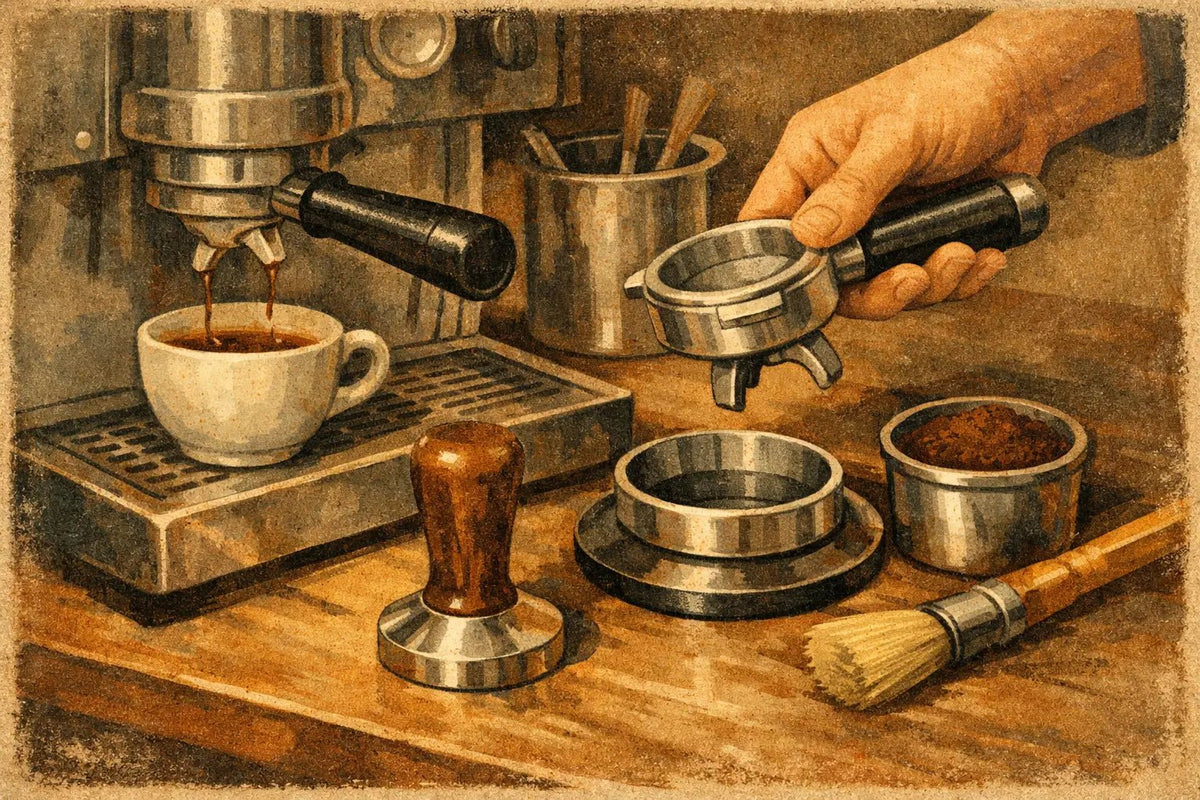
Portafilter compatibility is more involved than basket compatibility. The lugs that lock into the group head vary in thickness, spacing, and orientation. This is why a 58 mm portafilter for one E61-style machine may not lock properly into another machine that also takes a 58 mm basket. If you are buying a bottomless portafilter, replacement handle, or custom wooden handle, confirm the portafilter brand and model whenever possible.
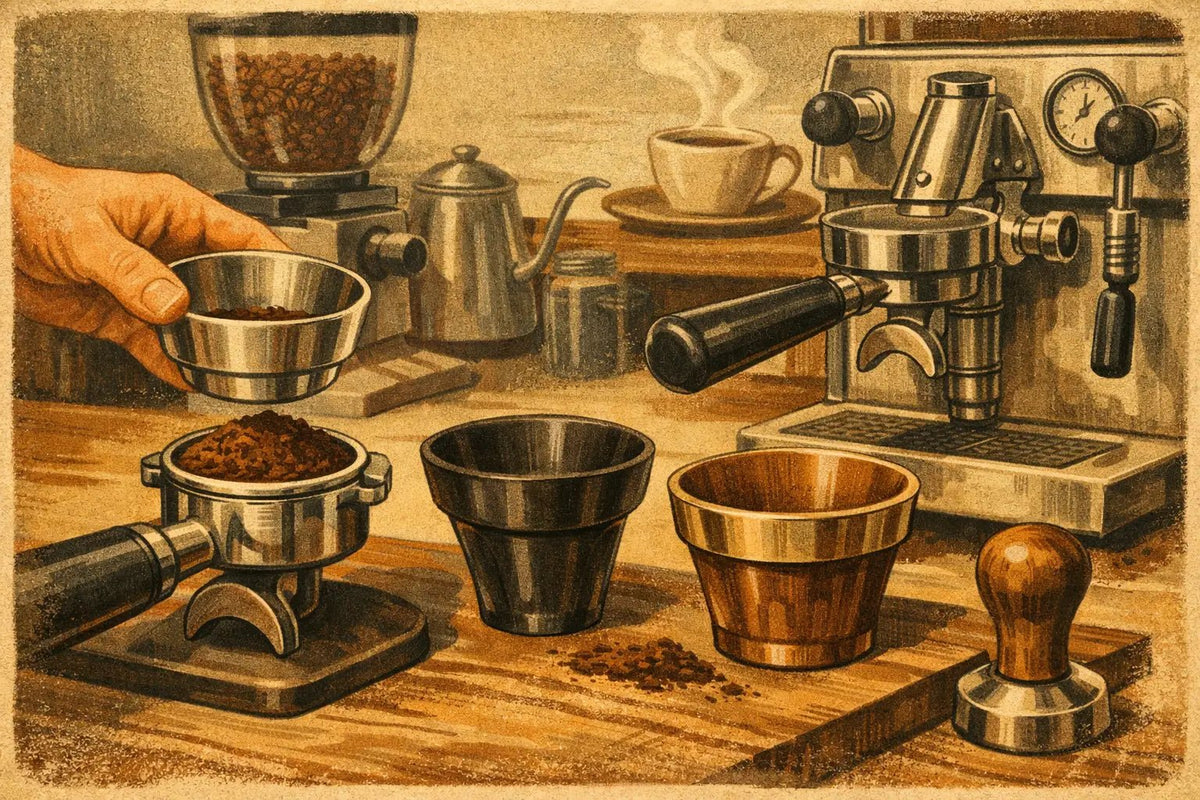
Dosing funnels also deserve a quick fitment check. Some are designed for 58 mm portafilters, while others are sized for 54 mm systems. Magnetic funnels need enough flat, magnetic surface to hold securely. A tall funnel can make distribution cleaner, but it may interfere with a grinder’s chute or require you to remove it before transferring the portafilter to a scale.
Consider Clearance and Daily Workflow
An accessory can fit mechanically and still create a problem at the bar. This is where a few minutes of practical thinking pays off.
A taller bean hopper lid may hit an overhead cabinet. A larger wood steam knob may sit close to a hot group head or protrude beyond a tight machine corner. A portafilter handle with a thicker profile may touch the drip tray, cabinet edge, or adjacent grinder when you lock in. A dosing cup may fit under the grinder but not clear the fork without removing it.
Wooden upgrades introduce one more consideration: natural material variation. Grain, tone, and figure make each piece distinct, while finish and shape influence grip. A rounded handle may be more comfortable for a long Saturday dialing-in session; a slimmer profile may better suit a compact setup. Neither is universally better. The right choice depends on your machine layout and how you use it.
When “Universal” Accessories Make Sense
Universal accessories are useful when the critical dimension is genuinely standardized. WDT tools, puck screens, dosing cups, tamping mats, knock boxes, and many scales can work across a wide range of espresso stations. Still, universal does not mean automatic.
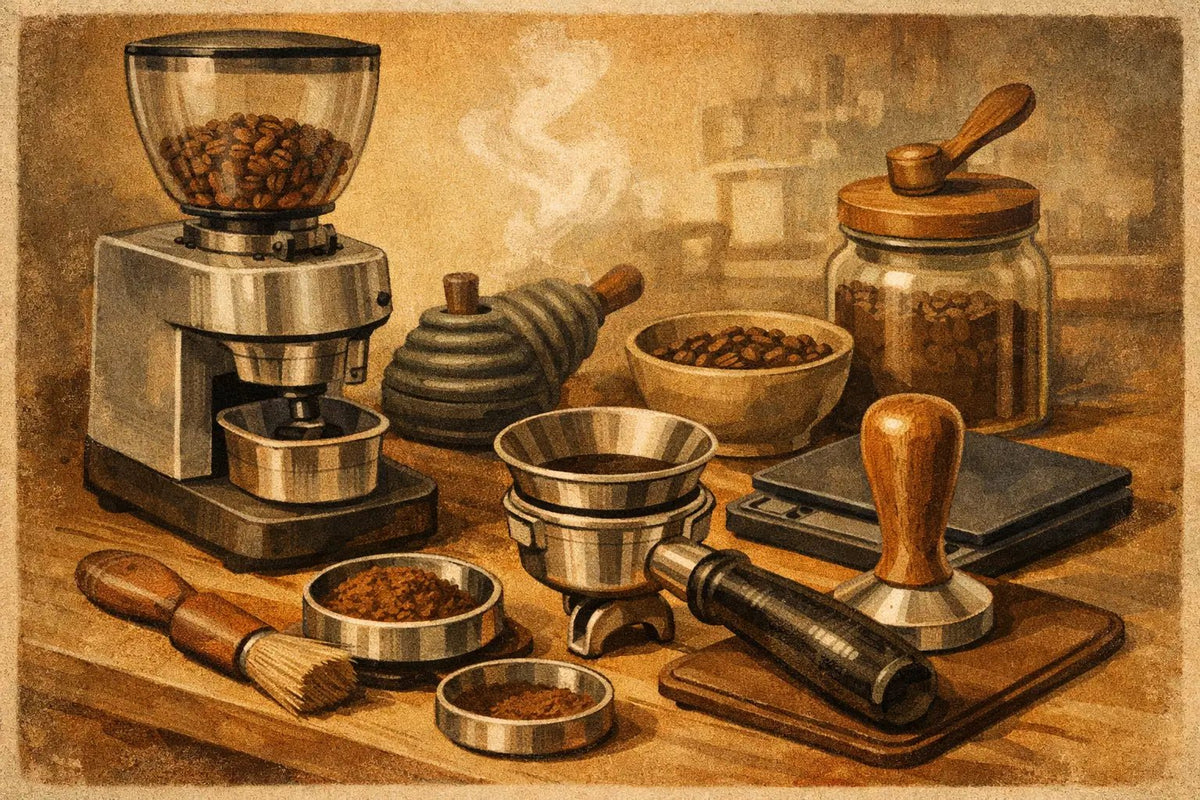
A puck screen must match the basket diameter and leave enough headspace. A scale must fit beneath the portafilter and cup while allowing the machine to drip without crowding the display. A WDT tool should reach the basket comfortably without tines catching on a narrow funnel. These are small details, but they determine whether an accessory becomes part of the routine or stays in a drawer.
For parts that mount directly to the machine or grinder, model-specific is usually the safer path. That includes portafilter handles, steam knobs, hot-water knobs, flow control knobs, hopper lids, drip tray components, and replacement hardware. The more integral the part is to your equipment, the less helpful a vague “fits most” claim becomes.
How to Avoid Compatibility Mistakes Before Ordering
Treat the product description as a fitment document, not just a color and material menu. Read the compatible model list closely and compare it with your exact equipment. If the listing specifies an original portafilter or original valve configuration, take that seriously.
When details are unclear, gather three things before asking for help: your full machine or grinder model, several clear photos, and the relevant measurements. For a custom portafilter handle, show the exposed metal thread and the complete portafilter. For a knob, show the original part, the stem, and the machine face. For a hopper lid, photograph the hopper from above and from the side.
NepoCoffee works best when the workshop has this information upfront. Custom work is not about making a part that is merely close. It is about confirming the interface, shaping the piece for the intended use, and producing an upgrade that looks deliberate on the machine.
Do Not Force a Part That Almost Fits
If a threaded handle starts but binds, stop. If a knob requires excessive pressure, do not push it onto the shaft. If a portafilter locks in unusually tight or sits at a strange angle, do not use it for brewing. Forcing a mismatched accessory can damage threads, valve stems, group-head lugs, or finishes that are much harder to replace than the accessory itself.
A good installation should feel controlled. The part should seat cleanly, tighten or lock with normal force, and allow the machine to operate as intended. After installation, test movement carefully before heating the machine or pulling a shot.
The best custom espresso upgrades make your setup feel more personal every time you reach for them. Take the extra moment to verify fitment, and you can choose with confidence rather than hoping a close match becomes the right one.