Espresso Workflow Tools Explained for Home Baristas
A great espresso setup does not need every new accessory on the market. It needs a repeatable sequence: grind, dose, distribute, tamp, brew, and clean up without creating avoidable variables. This guide to espresso workflow tools explained focuses on the accessories that make that sequence cleaner, faster, and more consistent - plus the tools that are worth choosing carefully for your machine and grinder.
For a home barista who already owns a capable grinder and espresso machine, workflow tools are often where the biggest day-to-day improvement happens. They reduce mess, help control coffee distribution, protect your equipment, and make a dialed-in recipe easier to repeat.
Espresso Workflow Tools Explained: What Each One Does
Workflow tools are accessories used between grinding and brewing. Some directly affect the coffee puck and can improve shot consistency. Others mainly improve speed, cleanliness, and comfort. Both matter, but they should not be confused.
A dosing funnel, for example, will not fix an uneven extraction on its own. It can, however, keep grounds inside the basket so your dose stays accurate and your counter stays clean. A WDT tool can improve distribution, but it cannot compensate for a grinder that produces an overly wide range of particle sizes. The best setup solves the specific friction points in your own routine.
Dosing funnels keep coffee where it belongs
A dosing funnel sits on top of the portafilter basket during grinding and distribution. Its job is simple: prevent grounds from spilling over the edge before you tamp.
This is especially useful with fluffy grinds, larger doses, bottomless portafilters, or grinders that throw coffee slightly off-center. It also gives you room to use a WDT tool without pushing grounds onto the counter. For many home baristas, a funnel is the first workflow upgrade that feels immediately useful.
Fitment matters more than it may seem. A funnel should match your basket diameter and sit securely without interfering with the portafilter rim, retention springs, or grinder forks. Common sizes include 58 mm, 54 mm, and 51 mm, but nominal size alone is not always enough. Machine families and basket shapes can vary, so confirm the actual compatibility before ordering.
WDT tools break up clumps before tamping
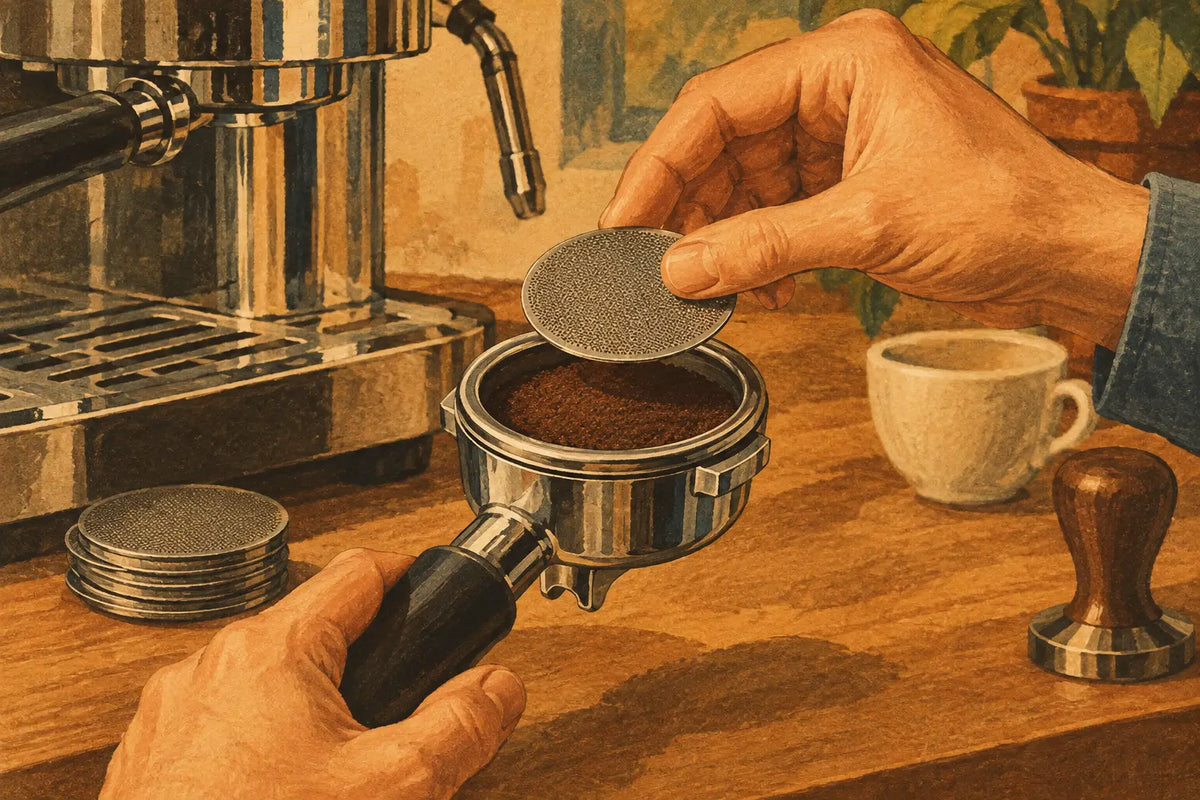
WDT stands for Weiss Distribution Technique. A WDT tool uses thin needles to stir freshly ground coffee in the basket, breaking up clumps and evening out the bed before tamping.
The goal is not to aggressively whip the coffee around. Use gentle, controlled circles through the full depth of the grounds, then level the surface with a few lighter passes near the top. The result should be a more uniform coffee bed with fewer dense pockets that can encourage channeling.
WDT is most helpful when your grinder produces visible clumps, when you use a fine espresso setting, or when you are chasing more consistency from light or medium-light roasts. It can still be useful with a strong grinder, but the improvement may be smaller. If your shots already run evenly and taste balanced, there is no need to turn a simple prep routine into a long ritual.
Needle thickness is worth considering. Very fine needles generally move through the grounds with less disruption. Thick pins can create larger channels and may simply push clumps around rather than separate them. A well-made WDT tool should also feel stable in the hand and store neatly near the grinder, because a tool only helps if you actually use it every day.
Distribution tools are not the same as WDT
Some accessories sit on the basket and rotate across the coffee surface. These are often called distribution tools or levelers. They can make the top of the puck look even, but appearance is not the whole story.
A rotating leveler can be useful as a finishing step, particularly if it helps you keep tamping depth consistent. But setting it too deep can compress the upper layer of coffee and leave the lower part less evenly distributed. That is why many experienced home baristas prefer WDT followed by a light settle or level, then tamping.
If you use a distribution tool, keep its depth shallow. Think of it as a surface-leveling accessory, not a replacement for proper distribution.
Tampers create a level, repeatable puck
Tamping compresses the coffee puck into a stable, level bed for brewing. Once the coffee is evenly distributed, the tamper should press straight down with a level face. Consistency matters much more than trying to apply a magical amount of force.
A tamper that matches the basket closely gives better edge coverage than an undersized one. Precision tampers are often made to fit high-quality 58 mm baskets with minimal side clearance, while 54 mm and 51 mm setups require their own correctly sized options. Measure your basket or check its manufacturer specification rather than assuming your machine's portafilter size tells the full story.
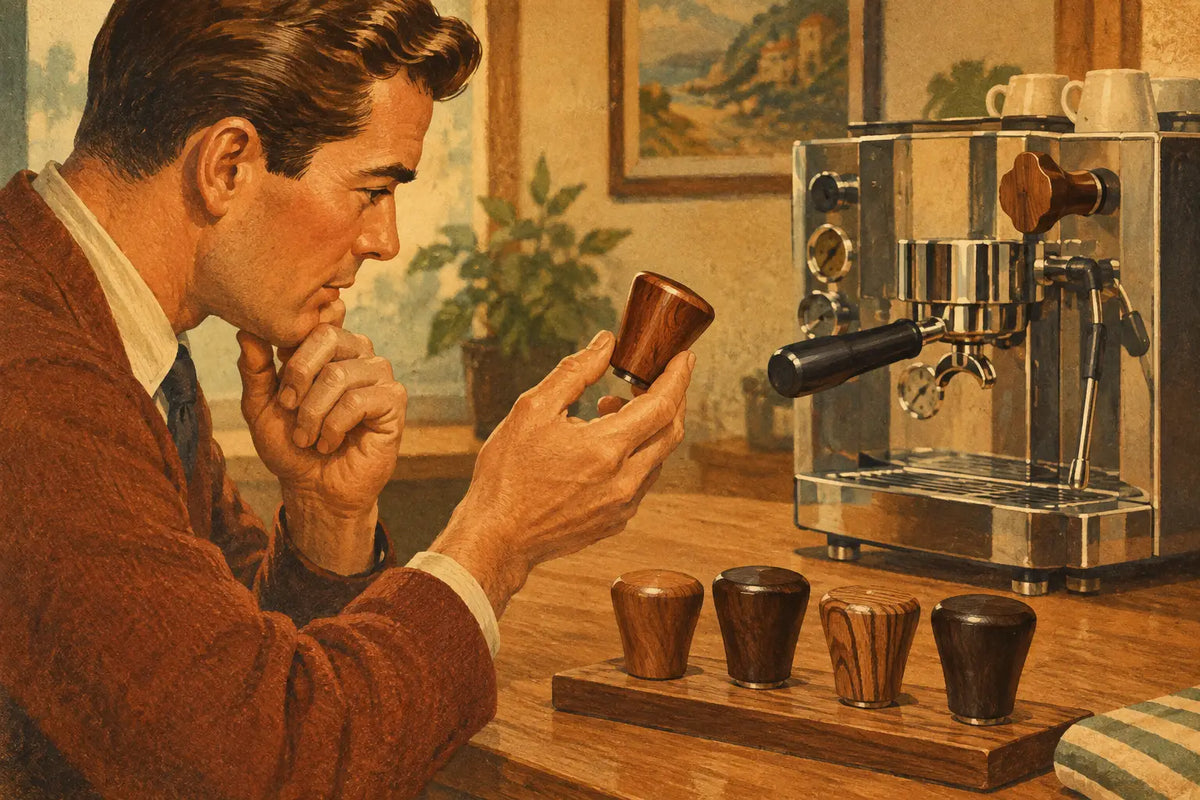
Spring-loaded and self-leveling tampers can help reduce variation, especially when several people use the same station. A traditional tamper remains an excellent choice if it feels comfortable and you can keep it level. Materials matter, too. Stainless steel provides a durable base, while a handcrafted wood handle can add warmth, grip, and a more personal connection to the machine.
Tamping mats and stations protect your counter and portafilter
A tamping mat provides a stable, cushioned surface for tamping. It protects countertops, prevents portafilter spouts or baskets from banging against hard edges, and gives your prep area a defined working zone.
A corner mat is useful when you tamp at the edge of a counter. A larger flat mat works well for a dedicated coffee bar with room for a tamper, WDT tool, and dosing funnel. Tamping stations provide more structure by holding the portafilter in a fixed position, which can be helpful for heavier machines or for baristas who want an ergonomic, repeatable angle.
This category is not about extraction alone. It is about preserving equipment and making the station feel intentional rather than improvised.
Knock boxes make cleanup part of the routine
After brewing, the spent puck needs to leave the basket cleanly. A knock box gives you a dedicated place to do that without damaging the portafilter or making trips to the trash after every shot.
Look for a stable base, a removable knock bar, and enough capacity for your typical day. A compact box is fine for one or two drinks at a time. If you make coffee for a household, a larger bin saves frequent emptying. Rubber feet and a padded bar also reduce noise, which is a welcome detail during early morning espresso.
Scales turn guesswork into a recipe
A compact espresso scale is one of the most useful tools in the entire workflow. It lets you measure dose, beverage yield, and shot time with enough accuracy to repeat a recipe.
Without a scale, a shot may look similar from one day to the next while actually varying by several grams. That difference can change strength, balance, and extraction. Measuring 18 grams in and 36 grams out, for example, gives you a clear starting point. From there, you can adjust grind size, yield, or time based on taste.
Choose a scale that fits under your cup or server, responds quickly, and can handle occasional splashes. Auto-tare and timer functions are convenient, but a simple fast scale is better than an oversized model that makes brewing awkward.
Build Your Espresso Workflow in the Right Order
The most effective upgrades usually follow the order of your actual routine. Start with the tools that address a real problem rather than buying accessories because they look good in a product photo.
If your counter is covered in grounds, start with a dosing funnel. If your shots spray or run unevenly despite careful dialing in, add a WDT tool and review your tamping technique. If your puck prep feels inconsistent, invest in a properly fitted tamper. If you are adjusting coffee by taste alone, add a scale before chasing more complicated upgrades.
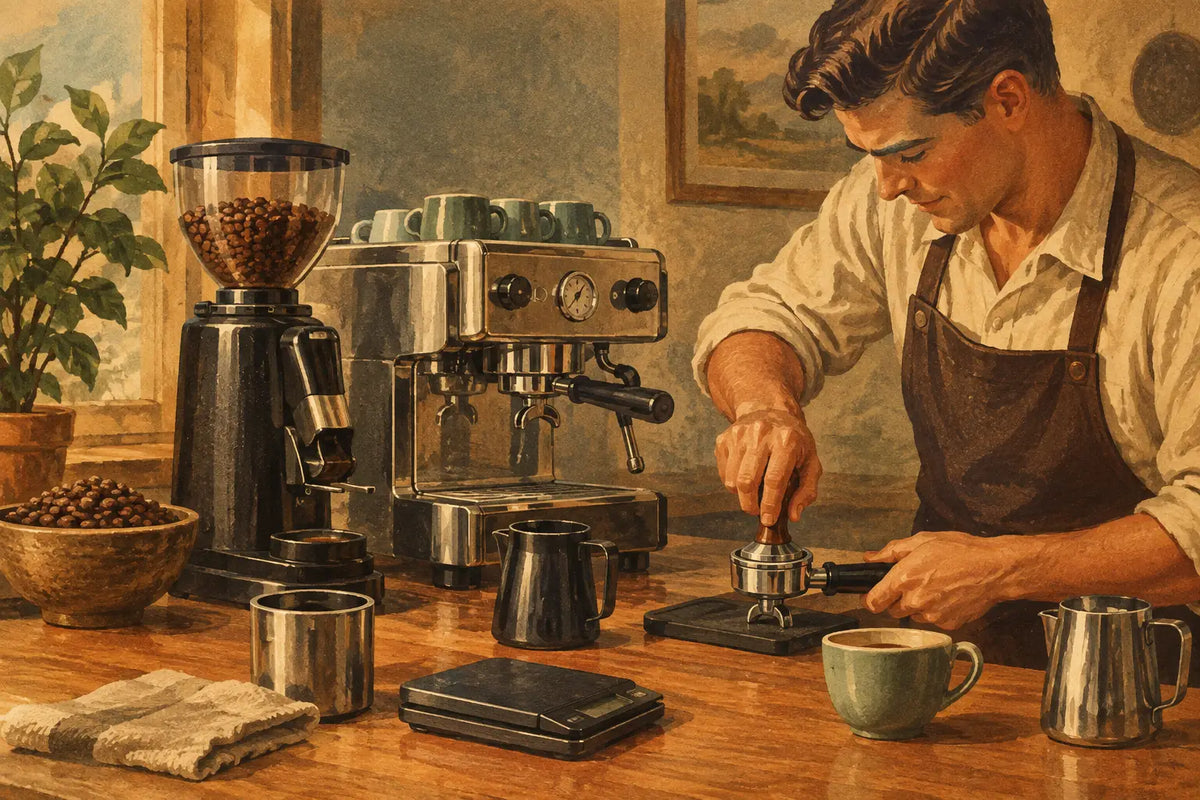
A practical workflow might look like this: weigh beans, grind into a portafilter with a funnel attached, use WDT, remove the funnel, lightly level if needed, tamp, brew on a scale, then knock out the puck and wipe the basket. Once that sequence feels natural, it takes very little extra time.
Choose Tools That Match Your Equipment
Compatibility is not a minor detail with espresso accessories. Portafilter diameter, basket shape, grinder clearance, magnetic versus non-magnetic surfaces, and machine-specific mounting points all affect whether an accessory works as intended.
This becomes even more relevant when upgrading visible machine parts. A wood portafilter handle, steam knob, bean hopper lid, grinder tray, or flow control knob can make a familiar setup feel completely your own, but the part needs to match the correct brand and model. Breville, ECM, Lelit, Rocket, La Marzocco, Gaggia, Bezzera, and Profitec machines all have model-specific details that should be checked before ordering.
At NepoCoffee, that fitment-first approach is part of the workshop process. Handcrafted accessories should look right, feel right, and function properly on the machine they were made for. For custom requests, clear photos, measurements, and machine model information help ensure the best result.
Do Not Let Accessories Hide a Basic Problem
Workflow tools support good espresso technique. They do not replace fresh coffee, a clean grinder, accurate dosing, or a properly dialed-in grind size.
If a shot is sour, bitter, fast, slow, or inconsistent, start with the basics. Check your dose and yield, confirm your grinder setting has not drifted, clean the basket and shower screen, and make sure the machine is properly warmed up. Then use workflow tools to remove remaining variables from puck preparation.
The right espresso tools should make your coffee bar calmer, cleaner, and easier to repeat. Build around the steps you perform every morning, choose pieces that fit your equipment precisely, and leave room for the small rituals that make pulling a shot feel like your own.