WDT Tool vs Distribution Tool for Espresso
A WDT tool vs distribution tool comparison matters most when your espresso tastes great one shot and thin, bitter, or uneven the next. Both tools work on the coffee bed before tamping, but they solve different problems. One breaks up clumps and mixes the grounds throughout the basket. The other levels the surface. Treating them as interchangeable can leave a weak point in an otherwise careful workflow.
For home baristas using a capable grinder, precision basket, and bottomless portafilter, the goal is not to add accessories for the sake of it. It is to create an even puck that resists water consistently. The right tool depends on your grinder, dose, basket, and how much variation you see from shot to shot.
WDT Tool vs Distribution Tool: The Core Difference
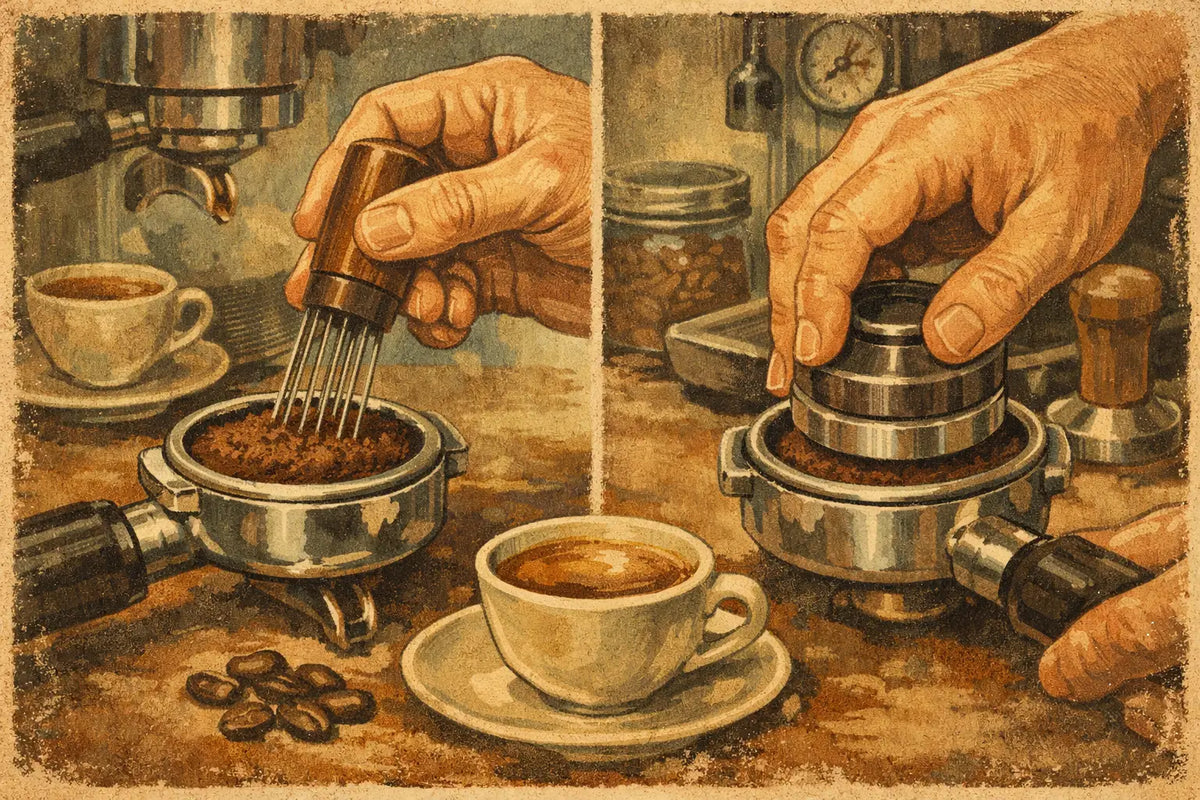
A WDT tool uses thin needles to stir freshly ground coffee in the portafilter basket. WDT stands for Weiss Distribution Technique. As the needles move through the grounds, they break up clumps, distribute coffee from dense areas into sparse ones, and reduce pockets of uneven density.
A distribution tool, often called a coffee leveler or espresso distributor, usually sits on top of the grounds and rotates. Its base may have angled fins, a patterned surface, or a flat leveling design. It is intended to create an even, level coffee bed before tamping.
That difference is more than cosmetic. WDT works within the puck, while a conventional distributor works mostly across the top of it. If your grind exits the grinder in clumps or piles up heavily in one area, a spinning leveler may make the surface look tidy without correcting the density underneath.
For this reason, WDT has become the more useful first step for many espresso enthusiasts. It directly addresses the uneven particle arrangement that can encourage channeling. A distributor can still have a place, but it is generally a finishing tool rather than a replacement for needle distribution.
What a WDT Tool Does for Extraction
Fresh espresso grounds do not always fall into the basket evenly. Static, grinder chute shape, roast level, and fine espresso settings can create clumps or send more coffee to one side of the basket. Even a good grinder can produce a small mound that needs attention.
Thin WDT needles let you gently rake the grounds from the bottom of the basket upward and across. The objective is not aggressive stirring. You are trying to make the coffee bed fluffy and uniform without compressing it before tamping.
A well-executed WDT routine can help reduce visible channeling in a bottomless portafilter, especially with lighter roasts and fine grind settings. It can also make shot times more repeatable. If you have ever changed nothing but your puck prep and suddenly stopped seeing fast, pale streams on one side of the basket, you have seen why WDT earns its place on the espresso bar.
Needle size matters. Very thick needles can push grounds around in larger tracks and may create their own unevenness. Fine needles, commonly around 0.25 to 0.4 mm, move through the coffee with less disruption. The tool should also fit your basket comfortably. A compact tool may be enough for an 18 g basket, while a wider pattern is more convenient for 58 mm portafilters.
A Better WDT Technique
Start with the portafilter resting in a dosing funnel if you use one. Insert the needles close to the bottom of the basket and make small circular or back-and-forth movements. Gradually work upward, paying attention to the edges where grounds often collect differently than they do in the center.
Avoid digging deep trenches or whipping the coffee like batter. Two or three calm passes are usually enough. When the grounds look evenly distributed, give the portafilter a light settle or tap only if your workflow needs it, then level the surface before tamping.
What a Distribution Tool Does Well
A distribution tool is useful for making the coffee bed level and preparing a consistent surface for the tamper. This can be especially convenient when you are dialing in at home and want a repeatable visual reference before every tamp.
The key is depth. Set too deep, a spinning distributor can compress the top layer of the puck. That may create a dense cap over looser coffee below it, which is not ideal for even water flow. Set shallow, it can gently sweep and level the surface with less risk of compression.
Some baristas prefer a simple dosing funnel, a few controlled taps, and a self-leveling tamper instead of a distributor. Others enjoy the repeatable feel of a leveler as part of their routine. Neither approach is automatically wrong. The test is whether your shots are consistent and taste balanced, not whether the puck looks perfectly patterned before it goes into the group head.
Distribution tools are particularly appealing for a clean, organized station. A well-made tool matched to your portafilter diameter feels deliberate in the hand and helps keep the workflow tidy. Just do not expect it to fix clumps from the grinder. Its strength is surface leveling, not internal redistribution.
Should You Use Both Tools?
Using both can make sense, but the order matters: WDT first, distribution tool second, then tamp. The WDT step handles clumps and density. The distributor lightly levels the top. A tamper then applies an even, controlled compression.
That said, many home baristas get excellent results with WDT followed by a careful tamp, with no spinning distribution tool at all. If you use a self-leveling tamper, that combination can be particularly efficient. The tamper helps establish a level puck, while WDT has already addressed the more meaningful issue below the surface.
Use both if the added leveler makes your preparation more consistent and enjoyable. Skip the distributor if it slows you down, compacts the puck, or adds no measurable improvement to flavor and shot repeatability. Espresso accessories should earn their counter space.
Choosing the Right Tool for Your Setup
Start with basket size and portafilter diameter. Most prosumer machines from ECM, Rocket, Lelit, Profitec, La Marzocco, and many other premium brands use 58 mm portafilters, but the basket’s internal diameter is what matters for a precise fit. Breville machines often use 54 mm portafilters, so a 58 mm distributor or funnel will not work properly even if it looks close enough.
For WDT, look for fine needles, a comfortable handle, and a layout that reaches your basket without scraping awkwardly along the wall. A handcrafted wood handle can add warmth and character to a daily ritual, but function still comes first: the tool should feel balanced and easy to control over the basket.
For a distribution tool, confirm the exact diameter and choose an adjustable model only if you will take the time to set it shallow and keep that setting consistent. A loose or poorly matched leveler can catch the basket edge, leave an uneven surface, or create frustration where the accessory was meant to save time.
NepoCoffee focuses on the kind of espresso accessories that make a machine feel personal as well as practical. Whether you are matching wood accents on a grinder tray and portafilter handle or selecting a tool for a specific basket, fitment and daily usability should lead the decision.
Signs Your Puck Prep Needs a Change
The clearest signal is inconsistency. If the same coffee, dose, grind setting, and yield produce noticeably different shot times, puck preparation may be part of the issue. It is not always the culprit - grinder retention, stale coffee, changing humidity, and temperature stability can all affect espresso - but prep is a practical variable you can control.
A bottomless portafilter can reveal obvious channeling, such as spraying, one-sided flow, or blonding that begins unusually early. Taste is equally useful. Sour, weak pockets alongside harsh bitterness often point toward uneven extraction. Before changing your recipe, try improving distribution with a calm WDT routine for several shots in a row.
Do not judge a tool after one pull. Pull three to five shots with the same coffee and recipe, recording dose, yield, and time. If the results tighten up and the flavor becomes more balanced, the change is helping. If nothing changes, simplify the process rather than adding more steps.
The best espresso workflow is the one you can repeat before your first coffee of the morning. Use WDT to solve clumps and uneven density, use a distribution tool only when it genuinely improves your leveling routine, and let the cup decide which tools stay on your bar.