Best WDT Tools for Home Baristas Who Care About Pucks
A bottomless portafilter tells the truth quickly. If your shot starts with a few pale, fast-moving streams or sprays from one side of the basket, the problem may not be your grinder setting. It may be the way dry coffee is distributed before tamping. That is why the best WDT tools for home baristas are not decorative extras. A well-made tool can make puck prep more repeatable, help break up clumps, and give your espresso a more even path from basket to cup.
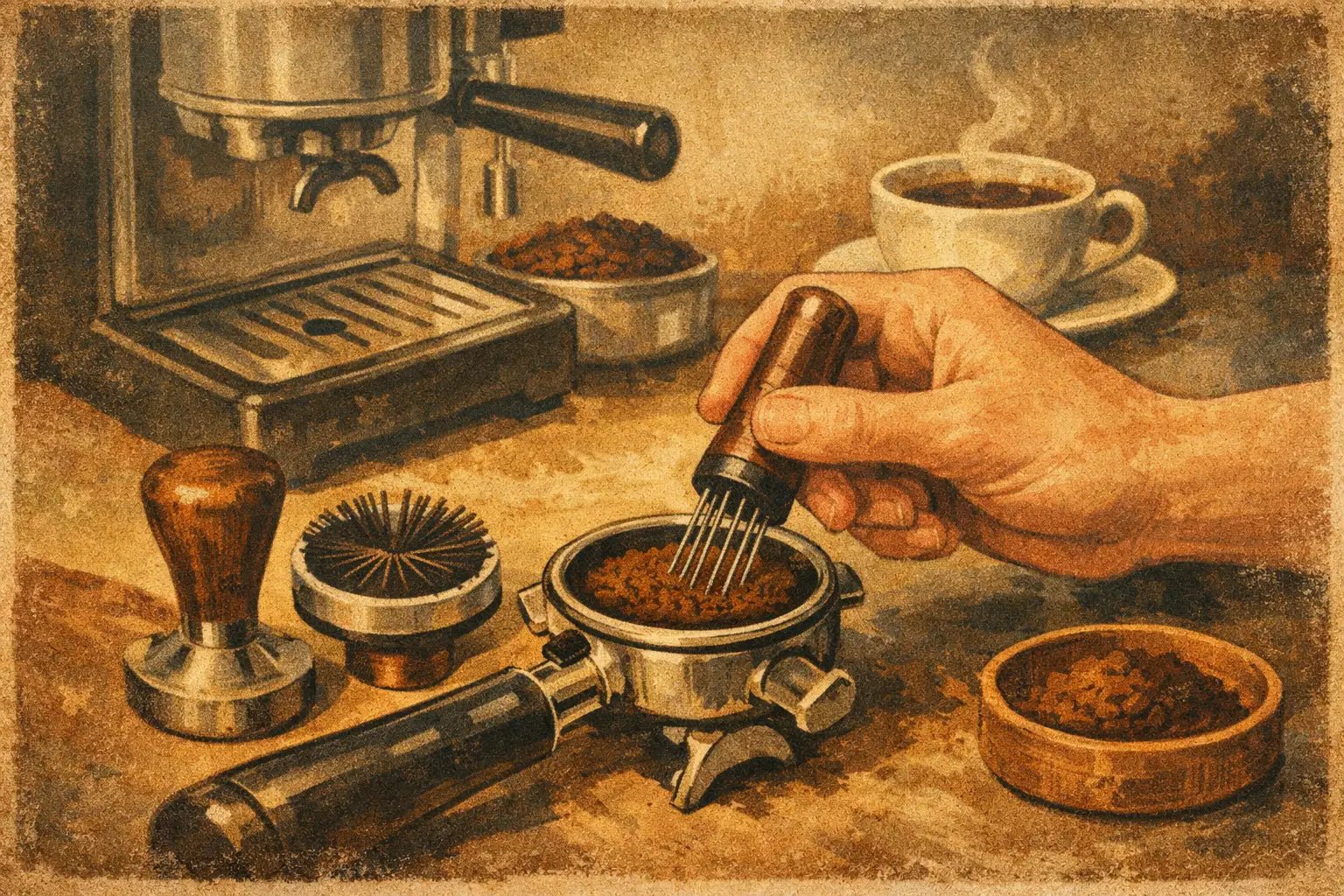
WDT stands for Weiss Distribution Technique. The method is simple: use very fine needles to gently stir the coffee bed in the portafilter basket before tamping. The tool itself is simple, too, but the details determine whether it improves your workflow or becomes another accessory sitting beside the machine.
What a WDT Tool Actually Fixes
Freshly ground coffee carries static, retains small clumps, and can land unevenly in the basket. This is especially common with single-dose grinders, darker roasts, humid or dry weather, and fine espresso settings. A dosing funnel helps keep grounds in the basket, but it does not fully distribute them. Tapping the portafilter can level the surface, yet it can also shift coffee toward the edges or create hidden density differences.
A WDT tool addresses the coffee beneath the surface. Fine needles separate clumps and move grounds into low areas so the puck has a more consistent density before you tamp. The goal is not to stir aggressively until the coffee looks fluffy. The goal is to create an even bed with as little disruption as possible.
That distinction matters. WDT can reduce channeling caused by poor distribution, but it cannot correct stale coffee, a severely misaligned burr set, an unsuitable basket, or a grind that is far too coarse. If a shot is running in 18 seconds, no accessory will replace a proper grind adjustment. Think of WDT as one useful control point in a careful espresso workflow.
Best WDT Tools for Home Baristas: What to Look For
The best choice depends on your basket size, dose, grinder behavior, and how much you value a clean, deliberate setup. Still, a few features separate a useful WDT tool from a novelty item.
Thin needles matter more than sharp-looking needles
Needles around 0.25 mm to 0.35 mm are the sweet spot for most home espresso preparation. They are thin enough to move through finely ground coffee without creating large tunnels or dragging big channels through the puck. Thicker needles can work, but they tend to push grounds around rather than delicately separating them.
Very thin needles require a little care. They can bend if pressed into a hard surface or left loose in a drawer, which is why a protective cap or stand is more than a cosmetic feature. For a busy coffee station, a tool that stores safely is easier to keep in daily rotation.
Needle count and spacing should suit your basket
Most capable WDT tools use several needles arranged in a small circular pattern. Too few needles can make distribution slower and less consistent. Too many can feel dense and difficult to move through the coffee, particularly in a narrower 51 mm or 54 mm basket.
For standard 58 mm baskets found on many ECM, Rocket, Profitec, Lelit, La Marzocco, and other prosumer machines, a tool with roughly six to nine fine needles is often comfortable. Smaller baskets may feel better with a more compact head and slightly fewer needles. The ideal layout allows you to reach the basket edges without scraping the wall or repeatedly pulling grounds out of place.
A stable handle improves repeatability
The handle is where a handcrafted WDT tool earns its place. A comfortable shape lets you use a light grip and small circular movements instead of digging into the coffee. It should feel balanced rather than top-heavy, with enough length to clear a dosing funnel if you use one.
Wood handles add warmth to an espresso bar full of stainless steel and black plastic, but the material should be properly finished for a kitchen environment. The handle should also be securely joined to the needle holder. A loose head or poorly aligned needles turns a precise tool into a frustrating one.
At NepoCoffee, this kind of small detail is the point of a handcrafted accessory: it should look at home beside a custom portafilter handle while still being made for the daily work of pulling shots.
A stand keeps the workflow clean
A stand is not required, but it is genuinely useful. Espresso prep involves loose grounds, wet towels, and hot metal surfaces. A WDT tool laid directly on the counter can collect coffee or damage its needles. A dedicated stand keeps the tool upright, protects the tips, and makes it easy to grab with one hand while holding the portafilter with the other.
If your station is compact, choose a stand with a small footprint and a weighted base. If you prefer an uncluttered counter, a capped tool that can be stored in a drawer may be the better fit. The right option is the one you will put away properly instead of leaving near the knock box.
Fixed, Adjustable, and DIY WDT Designs
Fixed-needle tools are the easiest recommendation for most home baristas. Their needle arrangement is set, they are ready to use, and there is little to adjust between shots. A thoughtfully made fixed design is often all that is needed for a consistent 18-gram dose in a 58 mm basket.
Adjustable tools allow you to change needle depth or spread. They can be helpful when you switch between baskets, use different doses, or want to experiment with how deeply you distribute. The trade-off is complexity. More moving parts mean more opportunities for needles to loosen, shift, or become uneven.
DIY WDT tools made from cork, wine stoppers, or 3D-printed handles can demonstrate the technique for very little cost. They are a fair starting point if you are unsure whether WDT belongs in your routine. However, needle alignment, safe storage, comfort, and durability are often inconsistent. Once WDT becomes part of every shot, a purpose-built tool usually feels like a worthwhile upgrade.
How to Use WDT Without Overworking the Puck
Start after grinding directly into the portafilter or transferring the dose into the basket. A dosing funnel is helpful because it gives you room to work at the top of the basket without scattering grounds across your machine tray.
Place the needles near the bottom of the coffee bed and make gentle, controlled circles as you move outward. Then raise the tool gradually through the grounds, continuing with small motions. Spend a little extra attention around the basket wall, where coffee can collect unevenly. You are trying to erase obvious clumps and fill low spots, not whip air into the dose.
Finish by lightly settling the grounds if needed, then level and tamp with a straight, consistent press. Avoid hard tapping after WDT. A sharp tap can undo the even distribution you just created, especially near the basket edges.
The entire process should take about five to ten seconds. If it takes much longer, simplify your movement. Espresso workflow is easier to improve when each step is repeatable rather than elaborate.
Pair the Tool With the Rest of Your Setup
WDT performs best as part of a connected preparation routine. A dosing funnel reduces mess and gives the needles room to move. A correctly sized tamper helps create a tidy puck edge. A level tamp and a clean basket rim support an even seal under the portafilter gasket.
Your grinder also changes what WDT can do. A grinder that produces fluffy, low-retention grounds may need only a brief pass. A grinder prone to static clumps may benefit from slower, more deliberate distribution. If you use a single-dose grinder, reducing static with a very small amount of water applied to the beans before grinding can also make the WDT step quicker. Use restraint - too much moisture is unnecessary and can create its own mess.
Keep an eye on the shot, not only the puck. If your espresso tastes balanced, reaches your intended yield and time, and flows evenly, your preparation is doing its job. A beautiful, perfectly groomed puck that produces a harsh or fast shot still calls for diagnosis.
When You May Not Need a WDT Tool
Some baristas get excellent results without WDT, particularly when using grinders with strong declumping performance and a stable dose routine. If your shots are already consistent, your bottomless portafilter shows even flow, and changes to distribution do not alter taste or timing, WDT may be optional rather than essential.
It is also possible to over-credit the tool. When dialing in a new coffee, adjust one variable at a time. Set dose and yield, find the right grind range, then make WDT a consistent part of the process before judging its effect. Otherwise, it is easy to confuse a distribution change with a grind change.
Choose a WDT tool that feels good in your hand, fits the scale of your basket, and can live safely on your coffee bar. Then use it with a light touch and enough consistency to let the coffee tell you whether it belongs in your daily ritual.