How to Choose a Dosing Funnel for Your Setup
A dosing funnel looks like a small upgrade, until you watch freshly ground coffee scatter across a portafilter rim, countertop, and machine tray. Knowing how to choose a dosing funnel means looking beyond the number stamped on your basket. The right funnel should fit your portafilter securely, work with your grinder and distribution routine, and stay out of the way when it is time to tamp.
For home baristas who weigh every dose and dial in regularly, a good funnel does more than keep the station clean. It makes the workflow more repeatable. You can grind directly into the basket, use a WDT tool without losing grounds, and move from dosing to distribution with fewer interruptions.
How to Choose a Dosing Funnel by Fit First
Fit is the first thing to get right, and “58 mm” alone is not always enough information. Many premium machines use nominal 58 mm portafilters, including many ECM, Rocket, Profitec, La Marzocco, Lelit, and Bezzera models. But the outside shape of the portafilter rim can vary, as can the basket lip, spout configuration, and the way a funnel attaches.
A funnel may sit inside the basket, grip the outside of the portafilter rim, or attach magnetically around the basket opening. These designs can all work well, but they require different measurements and offer different trade-offs.
Before ordering, identify your portafilter’s basket size and measure the relevant area for the funnel style you want. For a rim-fitting funnel, measure the outer diameter of the portafilter rim. For a funnel that sits in or over the basket, confirm the basket’s inner diameter and the width of its rolled edge. If you are replacing a funnel that already works, measure that one rather than relying on a generic machine specification.
This is especially useful with 54 mm systems. Breville 54 mm portafilters are common, but not every accessory labeled 54 mm has the same attachment geometry. A funnel made for one 54 mm setup may not sit securely on another. The same caution applies to 58 mm accessories: a 58 mm basket does not guarantee that every 58 mm funnel will clear the portafilter ears or sit flush on the rim.
Check the Basket and Portafilter, Not Just the Machine Brand
Machine compatibility is a helpful starting point, not the final answer. Some owners use aftermarket precision baskets, bottomless portafilters, or custom portafilter bodies. Each change can affect fit.
If a product is listed for your exact machine or portafilter model, that is the easiest route. If your setup is customized, compare measurements and ask the maker for guidance before ordering. A close fit is not the same as a proper fit. A funnel that shifts while you use WDT can turn a tidy accessory into another source of mess.
Choose the Attachment Style for Your Workflow
Most dosing funnels are either magnetic, friction-fit, or made to rest on the basket rim. The best choice depends on how you prepare espresso.
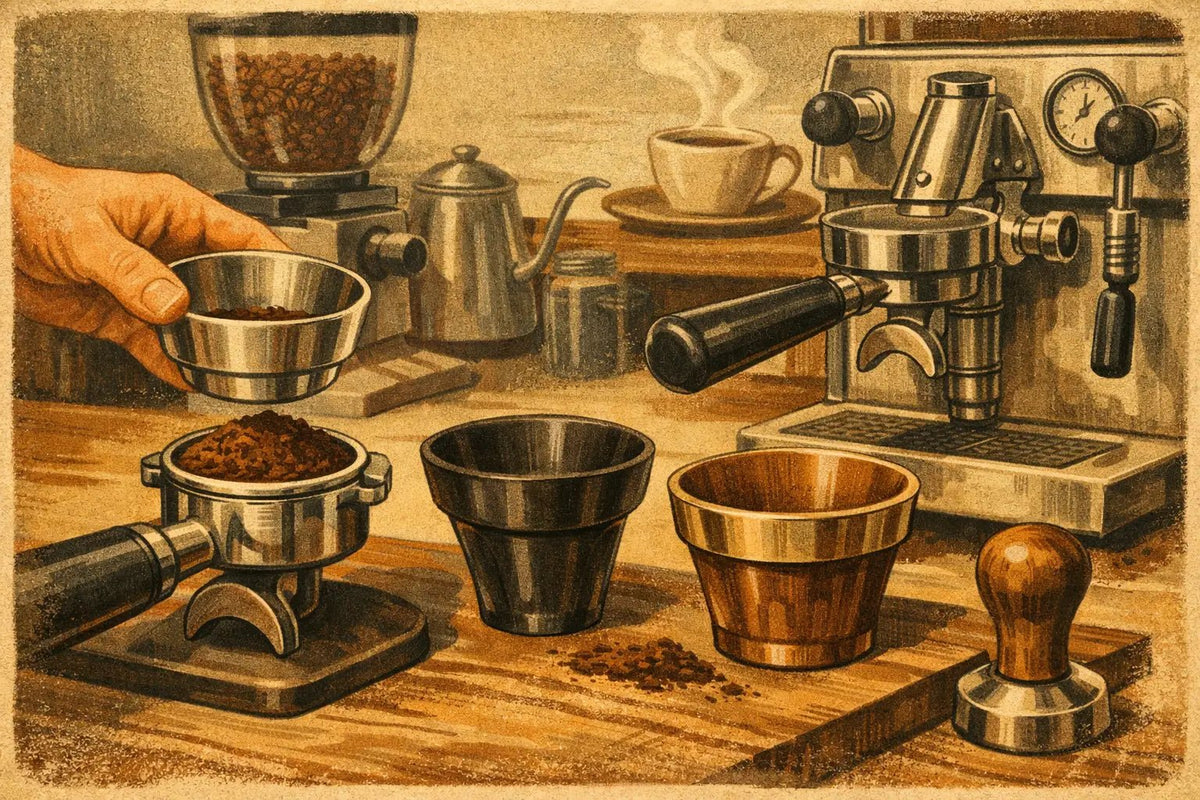
Magnetic funnels are popular because they are fast to place and remove. They work particularly well when you dose directly from a grinder, then use a WDT tool to break up clumps and distribute coffee evenly. The magnets should hold the funnel firmly enough that it does not move during distribution, without making removal awkward. Magnetic models only work with compatible metal baskets, so they are not a universal solution.
Friction-fit funnels grip the outside or inner edge of the portafilter. A well-made friction fit can feel very secure and does not depend on magnets. The downside is that tolerances matter more. If the fit is too tight, it can be frustrating to remove or may mark a finished portafilter. If it is too loose, grounds can escape through the gap and the funnel can lift when you withdraw a dosing cup.
Basket-rim funnels simply rest in position. They are easy to use and often compatible with a wide range of portafilters, but they can move more easily during vigorous distribution. They are a practical option for a calm, straightforward workflow, especially if you do not use an aggressive WDT technique.
Pick a Height That Solves the Real Problem
Funnel height affects both cleanliness and access. A shallow funnel may catch the light scatter from a grinder chute, but it can be too short if you use a dosing cup, grind fluffy light-roast coffee, or perform thorough WDT distribution. A taller wall gives you more working room and is usually the better choice for higher doses or active puck prep.
For most home espresso setups, a medium-height funnel is the practical middle ground. It contains grounds while leaving enough room to see and work inside the basket. Very tall funnels can be useful for high-volume grinding and extensive WDT, but they may interfere with low grinder chutes, portafilter forks, or dosing cups.
Think through your routine. If you grind directly into the basket from a grinder with limited clearance, measure from the portafilter basket to the grinder chute. A funnel that fits perfectly may still be inconvenient if it forces you to tilt the portafilter or remove the portafilter from the grinder fork for every dose.
Consider Dose Size and Coffee Style
Dose size is another reason height matters. An 18-gram dose in a standard double basket does not behave the same way as a 22-gram dose in a deeper basket. Fresh, light-roasted coffee can also exit the grinder with more volume and static, especially in dry conditions.
If you frequently switch baskets, choose a funnel that works with the basket you use most often. A funnel designed around a shallow basket may sit differently on a deeper or wider precision basket. There is no need to overbuild your setup for an occasional recipe, but a daily workflow deserves a funnel that handles your normal dose without compromise.
Material and Finish Matter More Than They Seem
Stainless steel and anodized aluminum are both excellent choices for dosing funnels. Stainless steel is durable, easy to clean, and naturally suited to a coffee station where tools get frequent use. Anodized aluminum is lightweight and can offer more finish and color options, making it appealing when you are coordinating accessories with a machine, grinder, or custom wood details.
Avoid funnels with rough inner seams, sharp edges, or a finish that feels thin around the contact area. Coffee grounds cling to rough surfaces, and a poorly finished edge can make cleaning harder. The inside wall should be smooth enough that grounds fall cleanly into the basket when you tap or remove the funnel.
A black finish can look excellent with a dark portafilter or grinder, but it also makes coffee dust more visible. Bare stainless hides light residue a little better, while colored finishes allow a more intentional look at the coffee bar. This is partly aesthetic, but it is not only aesthetic. A tool you enjoy using tends to stay in your routine.
Make Sure It Works With WDT, Tampers, and Dosing Cups
A dosing funnel should support the rest of your prep tools rather than create an extra step. If you use WDT, choose one with enough internal width for the tool to move around the full basket. A narrow opening can cause needles to catch on the wall, making it harder to distribute grounds evenly at the edges.
Most funnels need to come off before tamping. That is normal. Still, the removal should be clean and predictable. When you lift the funnel, it should not pull a ring of coffee grounds upward or disturb the level bed you just prepared. A smooth inner surface and a stable attachment design both help here.
If you single-dose with a dosing cup, check the funnel opening against the cup diameter. The cup does not need to nest inside the funnel, but it should be easy to pour without bouncing grounds off the edge. For direct grinding, confirm that the funnel and portafilter together fit under the grinder chute without awkward handling.
Do Not Buy on Size Label Alone
The most common mistake is buying a generic “58 mm magnetic funnel” and assuming it will fit every 58 mm portafilter. Sometimes it will. Sometimes it will sit high, wobble, cover too much of the basket, or fail to attach properly.
Good product information should clearly state the intended portafilter or basket compatibility, dimensions, attachment type, and funnel height. Clear photos of the underside and contact area are useful because they show whether the design sits on the rim, wraps around it, or depends on magnets. If your portafilter has an unusual shape, a custom handle, or a precision basket, share those details when requesting fitment help.
For a personalized espresso setup, details are the point. NepoCoffee approaches accessories with the same care used for custom machine parts and handcrafted upgrades: match the component to the actual equipment in front of you, not just a broad category name.
A well-chosen dosing funnel is a small piece of equipment that earns its place every morning. Get the fit right, give yourself enough room to distribute properly, and choose a finish that belongs beside the machine you have built your routine around.